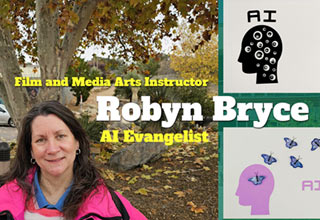
Prescott, Arizona (Dec. 3, 2025) – Only three years into her job at Yavapai College, Executive Director of Learning and Educational Innovation Robyn Bryce is in love with her role and her involvement with the school.
After working as a K-12 teacher in Pennsylvania and Bullhead City, Arizona, Bryce moved to Prescott in 2007, where she taught English and coached track and cross-country in the Prescott Unified School District for 15 years. She started taking personal interest classes at Yavapai College around 2014 and started working there as an instructional designer in 2022.
Constantly learning and exploring is a recurring theme in Bryce’s career and life path. While English is her foundation from an academic and teaching side, she is continually engaging with and investigating educational technology.
“Some of the other things that I'm good at is new media creation,” said Bryce. “So, whether that's film and media, whether that's posting things in short form content, whether that's 360 or XR and immersive experiences. New media and new media development I would say is something that I'm also comfortable with. If it's technology, I'm into it. Especially if it’s educational technology.”
Bryce oversees the Centers for Learning and Innovation on Verde Valley and Prescott campuses and is regarded institutionally as one of Yavapai College’s experts on AI. She says that emerging technology, particularly AI, is quickly changing the game.
“A lot of the tools with those new media and the ability to create, the ability to explore different ways to present information, whether from a faculty side or whether from a student side, it's so important because we are in a world that heavily relies on these technologies and is hugely changing the way that we learn, the way that we work, the way that we teach, the way that we experience the world,” Bryce said. “And so, not only is it about using these technologies, particularly like when we're talking about AI, but using them ethically, using them effectively, and understanding all of the use cases for them.”
Bryce says that the recent and widespread use of multiple AI platforms is not just about the ability to write an e-mail or to analyze data. The deployment of robots in learning spaces like labs has increased—she cites two examples of Yavapai College instructors Liz Peters and Cassi Gibson who have adopted this practice.
“Because I am an adjunct instructor for Film and Media Arts, though I'm taking a break this semester. And I just saw, it was either a Boston Dynamics or a Tesla robot that was second cameraman on a commercial shoot. So literally, a robot that was holding the camera. I saw a robot that was laying tile in a house using LIDAR” (Light Detection and Ranging, a remote sensing technology using light to create 3D models of a space).
Bryce knows that with the creep of AI in our personal and work lives, there’s a growing fear of humans being pushed out of all areas of employment. She concedes that there will be some shifts in the workforce, and that we may see robots and AI in different roles than we’ve been accustomed to, but she believes that rather than fear or fight against that shift, that we teach students how to work alongside those emerging technologies.
“I think that is like a mindset to get into instead of ‘how can we stop it? How can we prevent it? How can we battle it?,’” Bryce said. “The question should be, ‘how do we work with this? How do we find ways within our curriculum, within our skill sets, within our future, within our jobs, current and future?’ And there is such a bleeding between current and future right now. It's just happening so quickly.”
While she admits that we currently find ourselves in a cycle of disruption, Bryce that it’s both exciting and fascinating to be working for a wonderful institution that looks for solutions to those challenges.
Bryce says there are generally two general ideas or themes at play when we consider the future. The idea of future proofing is that we establish our institutions so that nothing can break down our barriers and the ways that we've done things, and we will absolutely make sure that we stand the test of time.
“Future ready, on the other hand, offers this idea of how we're going to learn and be agile and flexible and proactive as well as responsive to these things, so that no matter what comes at us, we can think about a future that may exist and prepare for these scenarios and prepare our students for these scenarios,” said Bryce. “Instead of embattling yourself against these things that are coming, it's more about working with them, preparing, being open, radical acceptance about what's coming and being open to it.”
Yavapai College operates seven campuses and centers throughout Yavapai County and offers over 100 degrees and certificates, four baccalaureate degrees, student and community services, and cultural events and activities. To learn more about Yavapai College, visit www.yc.edu.