Community
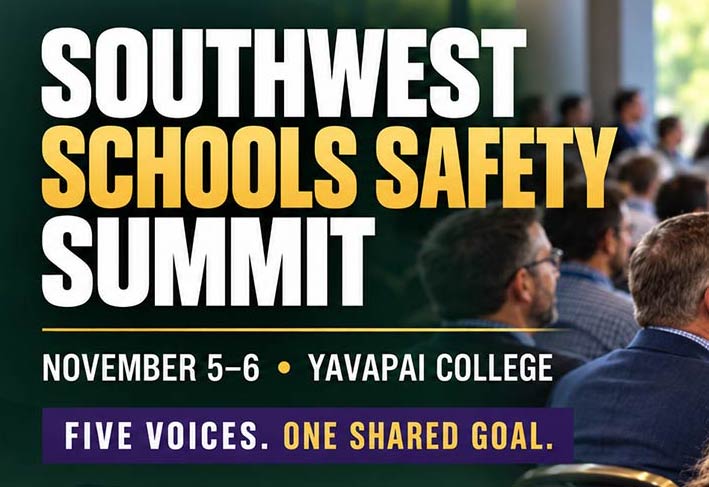
Yavapai College Hosts Southwest Schools Safety Summit Nov. 5-6
- Tim Diesch
- 29 October 2026
Prescott, Arizona — Yavapai College and the National Center for the Prevention of Community Violence (NCPCV) will host the Southwest Schools Safety Summit on Nov. 5 and 6 in Building 3, room 119 on its Prescott campus. The Summit runs from 8 a.m. to 4 p.m. on Thursday and 8 a.m. to 1:30 p.m. on Friday.
Register online at www.yc.edu/ji. The cost to attend is $125.00.
Attendees can expect to explore behavior-based strategies, prevention frameworks, and community factors that influence school safety and well-being. The Summit is an ideal conference to attend for K-12 educational leaders, school resource officers, teachers, and community members.
"With the focus of school safety across the nation being so much about technology, surveillance, and metal detectors, our Summit will concentrate on the behavioral cues present on campuses that school officials at all levels can recognize and realize when an intervention needs to occur before an event happens,” said Yavapai College Justice Institute Program Director Jerald Monahan.
“We also want to acknowledge that the concerning behavioral issues our schools are dealing with have a connection to the home environment where the student comes from and how do we work with the families to support their efforts at the social and emotional development of children."
Conversations are taking place in schools across the country about the increasing challenge of student behavior in the classroom. Working with schools in 25 states and communities serving more than 22,000 students, the NCPCV found that while every school is different, the concerns educators raise are remarkably consistent.
According to Wendy Davison, owner of Rocky Mountain Consulting, teachers aren't asking for more documentation or for more paperwork. And despite what many people assume, they usually aren't asking for harsher discipline. They're asking a different question: "How do we keep behavior from reaching a crisis in the first place?"
“That question has shaped many of the conversations we've had with teachers, principals, counselors, school resource officers, and district leaders,” Davison said. “Every partnership begins the same way. We listen. Before discussing recommendations, we spend time understanding what educators are experiencing. We ask what is working. We ask what is getting in the way. We ask what they need in order to spend more time teaching and less time managing behavior.”
Davison said that for years, schools have devoted tremendous energy to responding after behavior has already escalated. By the time a student is sent to the office, suspended, or requires crisis intervention, the opportunity for early prevention has often passed.
Instead of asking, "How do we respond when behavior becomes dangerous?" schools begin asking, "What is this behavior telling us, and what can we do before it escalates?" Davison said that shift changes more than discipline practices. It changes school culture. It changes how adults interact with students. It changes how safe a school feels, long before an emergency ever occurs.
Speakers at the Summit will be Bobby Kipper, Founder & Executive Director of the NCPCV; Dr. John Hodge, Chief Inspirational Officer for An Achievable Dream Urban Learning Leadership Center; Dr. Kenneth Trump, President, National School Safety and Security Services; Wendy Davison, owner of Rocky Mountain Consulting; and Jerald Monahan, Justice Institute Program Director at Yavapai College.
Yavapai College operates seven campuses and centers throughout Yavapai County and offers more than 100 degrees and certificates, six baccalaureate degrees, student and community services, and cultural events and activities. To learn more about Yavapai College, visit www.yc.edu